
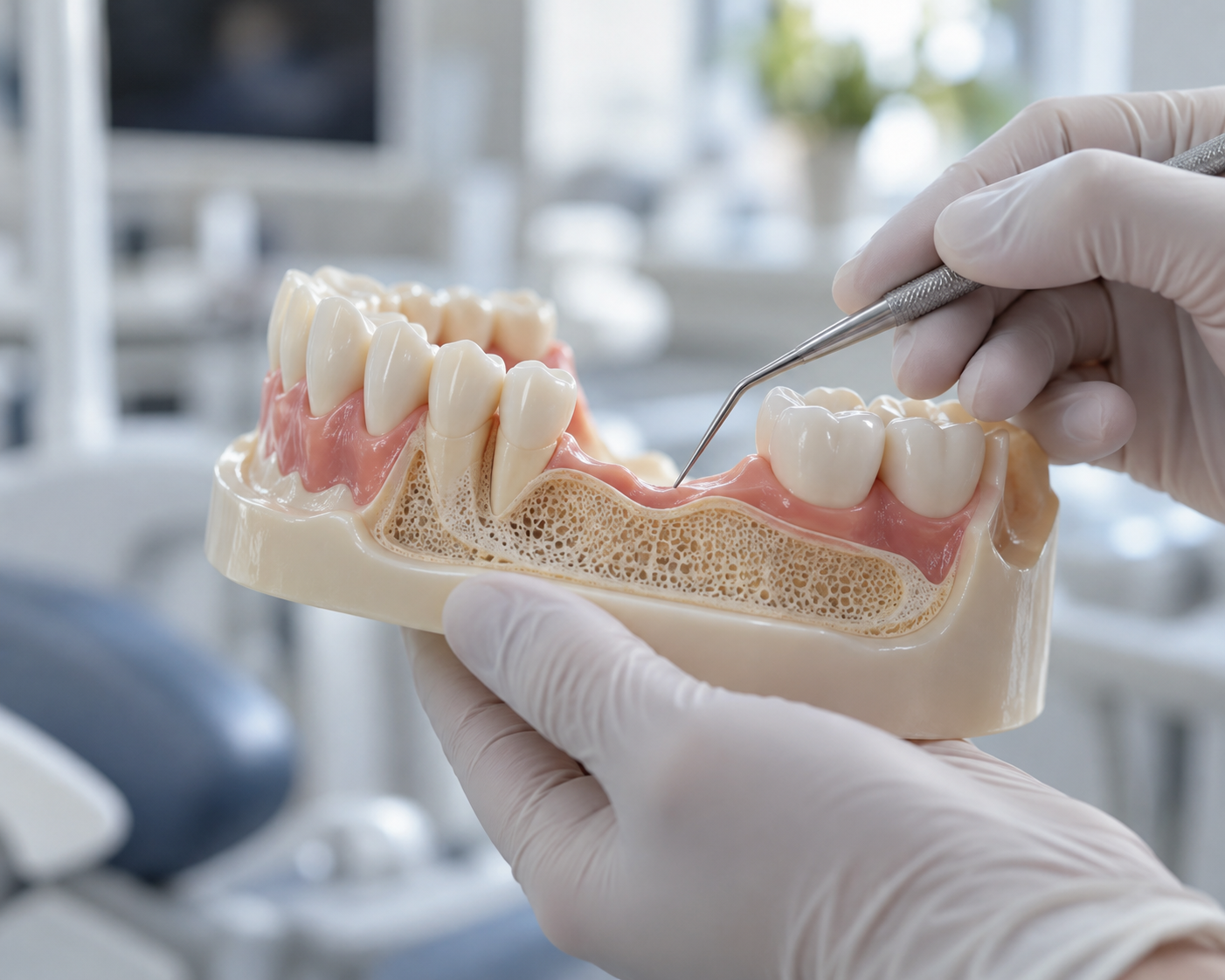
A lack of sufficient bone does not automatically mean that an implant is impossible. In many cases, bone can be reconstructed through bone augmentation procedures or, in the posterior region of the upper jaw, through a sinus lift. The indication is determined following a consultation and imaging studies.
Why does bone loss occur after losing a tooth?
The jawbone is not a completely static structure. After a tooth is lost, the area no longer receives the same stresses, and a remodeling process begins. Over time, the bone ridge may become narrower or lower.
Bone loss can also occur as a result of periodontal disease, infections, trauma, or previous tooth extractions. This is why two seemingly identical spaces between teeth can have very different bone volumes.
How does the doctor know if there is enough bone?
A clinical examination provides information about the gums and the shape of the alveolar ridge, but imaging is often necessary for implantology. CBCT can provide a three-dimensional view of the height and thickness of the bone, as well as its relationship to the sinus or the mandibular nerve.
SmileCity offers CBCT scans of the hemiarch, full arch, and both jaws. Current rates for diagnostic tests and surgery are available here.
What is bone formation?
Bone augmentation is a procedure that creates the conditions necessary for the formation and maintenance of adequate bone volume. Depending on the defect, the doctor may use different materials and techniques.
The graft acts as a scaffold for regeneration. Healing is not instantaneous: the body needs time to integrate and remodel the area.
What does GBR stand for?
GBR stands for guided bone regeneration. It is a technique used to treat certain bone defects, often in combination with bone graft material and a membrane that isolates the area during healing.
SmileCity lists horizontal bone regeneration (GBR). The exact indication depends on the shape of the defect and the position where the implant is to be placed.
When is a sinus lift necessary?
In the area of the upper molars, the maxillary sinus is located above the bone into which the implants would be placed. After tooth loss, the bone may become insufficient, and the sinus may occupy a larger portion of the area.
A sinus lift creates space for bone regeneration beneath the sinus membrane. There are internal and external techniques, which are chosen based on the patient’s anatomy and the amount of available bone.
Can bone grafting and implant placement be done on the same day?
Sometimes, yes. If there is enough bone to stabilize the implant and the defect can be augmented at the same time, the dentist may combine the procedures. In other cases, it is safer to reconstruct the bone first and insert the implant after healing.
The choice is not just about saving time, but about the biological predictability of the outcome.
How long does it take to heal after a bone graft?
Bone healing may take months, depending on the size of the graft, the technique used, and the patient. Medical resources for patients describe varying time frames, ranging from a few months to longer periods in cases of extensive bone augmentation.
The doctor aims to ensure the area has healed before moving on to the next stage. The timeline should be viewed as an estimate, not a guaranteed date.
Does bone growth hurt?
The procedure is performed under anesthesia. After the procedure, swelling, tenderness, and discomfort may occur. The experience depends on the extent of the procedure and the area treated.
You should tell your doctor if you experience worsening pain, discharge, fever, or increasing swelling.
Are there situations in which an implant is not the best solution?
Yes. Just because it is technically possible to rebuild bone does not mean that every patient should automatically choose this option. The patient’s overall health, smoking status, oral hygiene, periodontal disease, costs, time, and prosthetic alternatives must all be taken into account.
The right treatment plan is one that resolves the patient's problem while ensuring reasonable levels of risk and long-term care.
What should you ask during your appointment?
- how much bone there is and where the deficiency lies;
- whether the addition can be performed at the same time as the implant;
- what type of procedure is being proposed;
- What is the estimated recovery time?;
- whether a sinus lift is necessary;
- What options are available if you don't want a bone graft?.
These answers will help you understand much better why your treatment plan may differ from that of another patient.
What factors influence the success of a bone graft?
The outcome depends on the size of the defect, blood supply, the stability of the material, gum health, and adherence to postoperative instructions. Smoking and oral inflammation can be significant risk factors.
The doctor considers not only the amount of bone harvested, but also whether the resulting volume allows the implant to be placed in the appropriate prosthetic position.
Are there any alternatives if I don't want a bone graft?
Sometimes there may be different prosthetic options, such as modifying the implant treatment plan or choosing a bridge or denture. In other situations, avoiding a graft would mean placing the implant in an unfavorable position, which is not recommended.
The alternatives must be analyzed on a case-by-case basis. The question is not just whether the transplant can be avoided, but what trade-offs arise if we avoid it.
How do you prepare for your appointment, and what information should you bring?
Make a note of when the problem started, what symptoms you’re experiencing, what dental treatments you’ve had in that area, and what medications you’re currently taking. If you have X-rays, CBCTs, medical reports, or documents regarding implants and previous dental work, bring them to your appointment. Tell your dentist if you smoke, have any allergies or chronic conditions, or are undergoing treatments that could affect healing. It’s also helpful to specify what concerns you most: pain, duration, aesthetics, cost, or the number of procedures. An effective consultation isn’t just about receiving a diagnosis—it’s about understanding your options, the sequence of steps, and the reasons why a particular approach is recommended. Ask for clarification if a term is unclear, and ask what happens if you choose to postpone treatment or opt for an alternative. This way, you can make an informed decision and accurately compare your options, rather than relying solely on the price of a single procedure.
Frequently Asked Questions
If I have no bone at all, is an implant impossible?
It is impossible to answer without an evaluation. Some deficits can be corrected, while others require complex techniques or prosthetic alternatives.
What test is used to determine the bone suitable for an implant?
CBCT is often used for 3D evaluation of bone and anatomical structures.
Is bone grafting performed before or at the same time as the implant placement?
Both options are possible, depending on the available stability and the size of the defect.
Is a sinus lift the same thing as bone grafting?
It is a form of bone augmentation specific to the posterior region of the upper jaw.
Does smoking affect healing?
Smoking is an important factor to discuss with your doctor, as it can affect healing and treatment risks.