
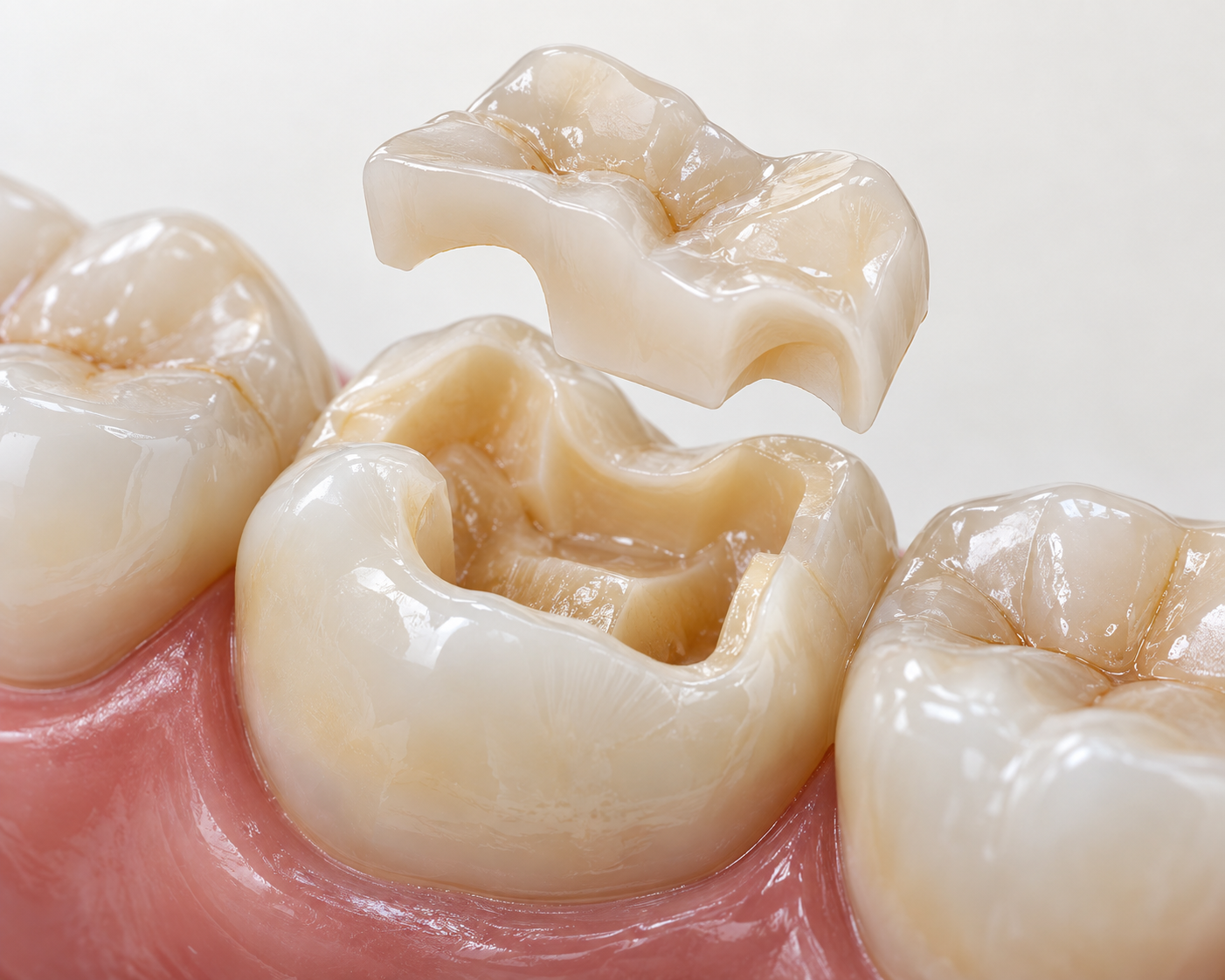
Between a regular filling and a full crown, there is, in certain cases, an intermediate option: an inlay or onlay. These restorations are fabricated outside the mouth and cemented onto the tooth; they are used when the loss of tooth structure is too extensive for a simple filling, but a full crown is not necessarily required.
What Is an Inlay?
An inlay is a restoration that is placed within the chewing surface of the tooth without extensively covering the cusps. It is shaped to fit the exact contours of the cavity and can be made from ceramic materials such as Emax.
What Is an Onlay?
An onlay covers a larger area and may include one or more cusps of the tooth. It is useful when those areas are weakened and need additional protection, but the rest of the tooth can be preserved.
When might a regular filling not be enough?
If a large portion of the tooth is damaged or the filling becomes very large, the composite material may be subjected to significant forces and may be at a higher risk of fracture or wear. In such cases, the dentist may consider an indirect restoration.
When might a crown be necessary?
A crown is recommended when a tooth requires more extensive coverage and structural protection. The decision depends on the amount of healthy tooth structure, cracks, previous treatments, the tooth’s position, and the forces involved in chewing.
Why can an inlay or onlay be a more conservative treatment?
Because it allows for the preservation of healthy areas of the tooth that would otherwise be removed if a full crown were prepared. The principle is to restore only the part that needs strengthening, when the case allows.
What are the advantages of Emax for inlays and onlays?
Emax ceramic offers strength and a natural-looking appearance, making it suitable for indirect restorations when indicated. SmileCity lists Emax inlays and onlays among its prosthetic services.
How long does an inlay or onlay last?
Longevity depends on the size of the restoration, adhesion, oral hygiene, bruxism, and masticatory forces. There is no single timeframe that applies to all patients. Regular checkups help with the early detection of any potential problems.
How much do Emax inlays/onlays cost at SmileCity?
SmileCity publishes a separate price list for Emax inlays/onlays, as well as for fillings and crowns. For the most up-to-date prices, visit the SmileCity pricing page. See SmileCity prices
How do you know which option is right for you?
The decision cannot be based solely on the visible size of the filling. The dentist must evaluate the remaining tooth structure, the presence of cracks, occlusal contacts, and the tooth’s history. The goal is a restoration that is sufficiently strong, yet as conservative as possible.
What exactly is an inlay or onlay?
Inlays and onlays are restorations made outside the mouth, usually from ceramic, which are then bonded to the prepared tooth. An inlay repairs the area inside the cusps, while an onlay can cover one or more cusps when they need protection. They are larger than a regular filling but can preserve more healthy tooth structure than a crown in appropriate cases.
When does a filling become too large?
There is no single criterion that dictates when a filling should be replaced with another type of restoration. The dentist evaluates the thickness of the remaining tooth structure, the presence of fissures, the tooth’s position, and the forces involved in the bite. If a filling would leave the cusps very thin and vulnerable, an onlay can provide better protection by covering them.
When is a crown the best option?
A crown is considered when a tooth has lost a significant amount of structure, is weakened across multiple surfaces, or requires circumferential coverage. Teeth that have undergone root canal treatment may also need additional protection, depending on the amount of remaining tooth structure. The goal is to preserve the tooth while also providing sufficient strength for long-term function.
Why is Emax used for certain inlays and onlays?
Emax ceramic offers a good balance of strength, precision of fit, and aesthetics. Whether fabricated in the lab or using a digital workflow, the restoration can replicate the shape of the tooth and its contacts with adjacent teeth. However, the indication depends on the tooth’s position, the thickness of the material, and the bite; the material does not automatically make every case a candidate for an onlay.
How long can an inlay or onlay last?
The lifespan depends on the condition of the tooth, the quality of the bond, oral hygiene, new cavities, and chewing forces. Bruxism and the habit of biting on hard objects can also affect these restorations. Regular checkups allow for monitoring of the margins and the tooth beneath them. The goal is a predictable and conservative solution, not just one that is „more modern” than a filling.
How is the most conservative solution determined?
The dentist tries to preserve as much of the tooth’s healthy structure as possible, without compromising its strength. If a filling can provide sufficient support, a more extensive restoration is not necessary. If the tooth walls are fragile, an inlay or onlay can protect the vulnerable areas. If the tooth is severely compromised, a crown may be the more predictable solution. The right choice is the one that balances preservation and strength.
Is a root canal necessary before an onlay or crown?
Not necessarily. A tooth can receive an onlay or a crown even without root canal treatment if the pulp is healthy. Root canal treatment is indicated only when there are biological reasons for it, such as irreversible damage to the pulp or certain complications. The type of restoration and endodontic treatment are separate decisions.
Why is a follow-up visit after restoration important?
After cementing or filling the tooth, the dentist checks the bite and the fit. At subsequent checkups, the dentist monitors the edges of the restoration, oral hygiene, and any signs of cracks or cavities. Even a well-done restoration still requires ongoing maintenance and monitoring.
Frequently Asked Questions
Is an inlay/onlay the same thing as a filling?
No. It is an indirect restoration, made separately and then cemented onto the tooth.
Is it more conservative than a crown?
In many cases, yes, because it does not require covering the entire tooth.
Can it be used on any tooth with a large filling?
No. The recommendation depends on how much healthy tissue remains and on the structural condition of the tooth.
Is Emax suitable for onlays?
Yes, for the appropriate indications, and SmileCity offers Emax inlays and onlays.
When is a crown the best option?
When a tooth requires more extensive coverage and structural protection.