
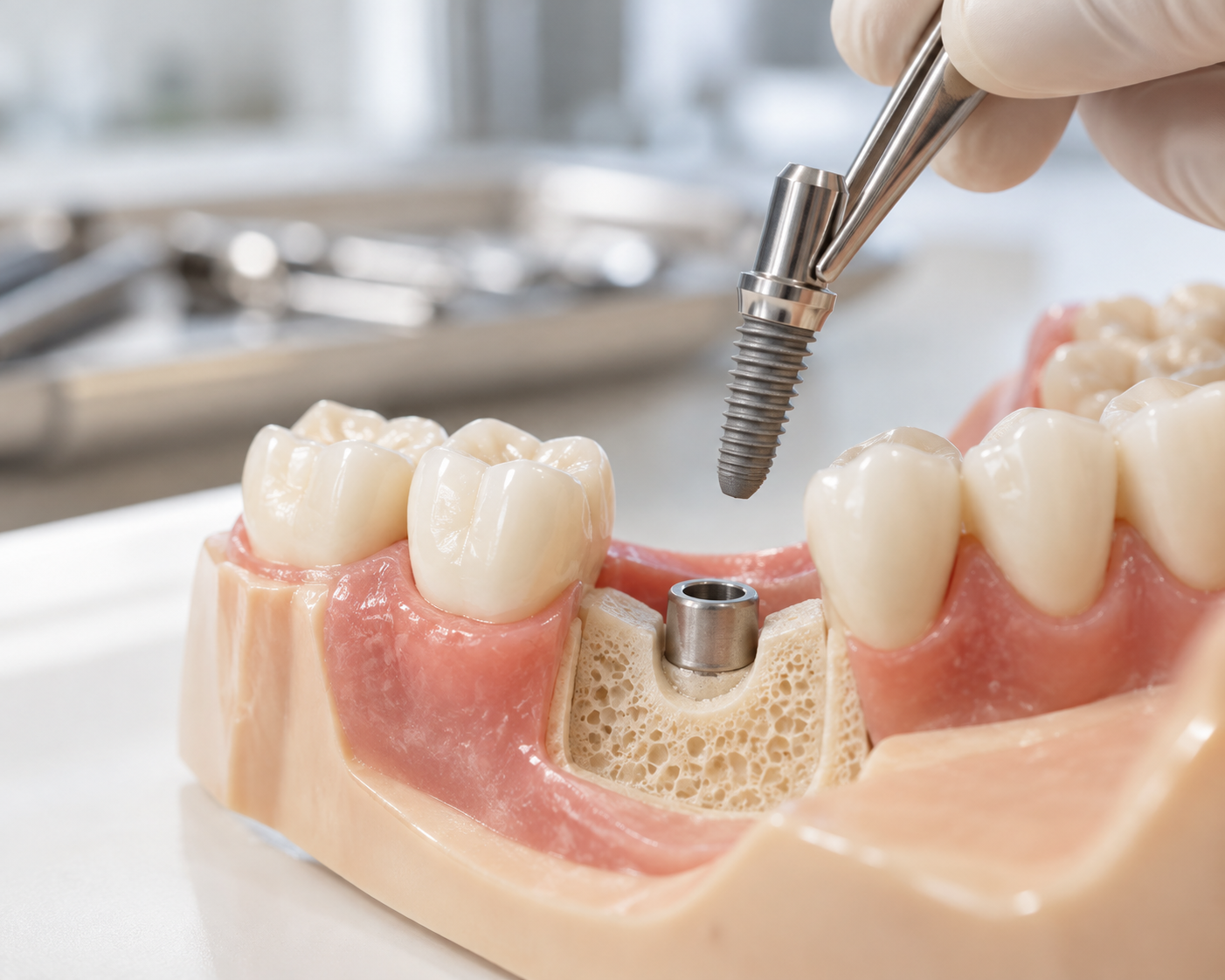
In some cases, the implant can be placed immediately after extraction; in others, it may be placed after a few weeks or a few months. The right timing depends on the presence of infection, the amount of bone, the stability of the implant, and the treatment plan—not on a fixed rule that applies to all patients.
Why does the timing of implant placement matter?
After extraction, the bone and gum begin to remodel. The dentist tries to choose a time that provides sufficient stability for the implant and good healing conditions, without making the procedure more complex than necessary.
Placing the implant as quickly as possible is not always the primary goal. The goal is to place it in the correct position and in tissue capable of supporting it.
Option 1: Implant placed immediately after extraction
In some cases, the tooth is extracted and the implant is placed during the same appointment. The advantage is that it can reduce the number of procedures and shorten certain stages of treatment.
For this to happen, favorable local conditions must be present. The dentist evaluates the remaining bone, the infection, the gum tissue, and the possibility of achieving primary stability. Not every post-extraction socket is suitable for immediate implant placement.
Option 2: Implant after initial healing
Sometimes the dentist prefers to allow the tissues to begin healing before placing the implant. This strategy can be useful when local conditions need to stabilize or when a clearer assessment of the tissues is needed after extraction.
The exact timeframe varies from case to case. It is not recommended to choose a timeframe on your own simply after reading about another patient's experience.
Option 3: Implant placement after more complete bone healing
In some cases, patients must wait several months before the implant is placed. This may be necessary following infections, bone loss, or regenerative procedures.
The disadvantage is that it takes longer, but sometimes this phased approach simplifies the monitoring of biological conditions and allows for bone regeneration prior to implantation.
What role does the infection play?
The presence of an infection does not automatically lead to the same decision for all patients. The doctor must assess the extent of the problem, the available bone, the feasibility of debridement, and the risks of the procedure.
If you have swelling, discharge, or pain in the tooth that is to be extracted, tell your doctor about all your symptoms and the treatments you have undergone. The implant treatment plan begins with an assessment of the local condition.
What happens to the tooth after it is extracted?
After a tooth is lost, the bone in that area undergoes remodeling and may lose volume. For this reason, the time of extraction is a good opportunity to discuss tooth replacement options, even if the implant will not be placed immediately.
In some cases, the doctor may recommend preserving or augmenting the area to ensure favorable conditions for a future implant.
When is bone grafting necessary?
If the bone is insufficient in width or volume, a bone regeneration procedure may be necessary. SmileCity offers horizontal bone augmentation, as well as internal and external sinus lifts, for cases where the posterior maxillary region requires additional volume. View the current price list.
Sometimes the grafting procedure can be performed in conjunction with the implant; other times, it is performed in a separate stage, and healing is allowed to occur before the implant is placed.
Do I need to get a CBCT scan after the extraction?
Imaging is recommended based on the clinical situation. For implant planning, CBCT can provide three-dimensional information about the bone and surrounding anatomical structures. This does not mean that every patient must undergo the same imaging test at the same time.
According to current recommendations in dental radiology, imaging should be ordered when the information obtained is necessary for diagnosis and treatment planning.
What should you do if it's been a long time since you had your tooth pulled?
The fact that the extraction took place years ago does not automatically rule out an implant. However, it is possible that the bone has resorbed, and this needs to be assessed.
A consultation and imaging tests can determine whether the implant can be placed directly or whether bone reconstruction is necessary.
A Useful Question to Ask During Your Appointment
Instead of asking, „How many months do I have to wait?”, ask, „What condition must be met before the implant in my case?” The answer may relate to tissue healing, bone, infection control, or an additional procedure.
This wording helps you understand the reason behind the timeline, not just the estimated date.
What does alveolar preservation after extraction mean?
In some cases, the dentist may recommend a procedure to preserve the alveolar socket in order to limit bone loss after extraction. Augmentation material may be placed in the remaining space to ensure better conditions for a future implant.
This procedure is not necessary after every extraction and does not guarantee that no further procedures will be needed, but it can be part of the implant treatment strategy when the implant is not placed immediately.
Why is it a good idea to discuss the implant before the extraction?
If you know that the tooth cannot be saved, it is best for the dentist planning the replacement to be aware of the situation before the extraction. The way the tooth is extracted and how the socket is managed can influence future options.
This does not mean that every extraction must be performed by an implantologist, but rather that planning ahead can prevent decisions from being made after the bone has already remodeled.
How do you prepare for your appointment, and what information should you bring?
Make a note of when the problem started, what symptoms you’re experiencing, what dental treatments you’ve had in that area, and what medications you’re currently taking. If you have X-rays, CBCTs, medical reports, or documents regarding implants and previous dental work, bring them to your appointment. Tell your dentist if you smoke, have any allergies or chronic conditions, or are undergoing treatments that could affect healing. It’s also helpful to specify what concerns you most: pain, duration, aesthetics, cost, or the number of procedures. An effective consultation isn’t just about receiving a diagnosis—it’s about understanding your options, the sequence of steps, and the reasons why a particular approach is recommended. Ask for clarification if a term is unclear, and ask what happens if you choose to postpone treatment or opt for an alternative. This way, you can make an informed decision and accurately compare your options, rather than relying solely on the price of a single procedure.
Frequently Asked Questions
Can an implant be placed on the same day as an extraction?
Yes, in select cases, provided that the local conditions are suitable and adequate stability can be achieved.
If I've had an infection, can I still get an implant?
Often, yes, but the timing and steps depend on the local situation and infection control measures.
If I wait too long, will I lose bone mass?
After extraction, the bone undergoes remodeling and may lose volume, which is why it is important to discuss replacement options early on.
Can I have a temporary tooth between the extraction and the implant?
In many cases, there are temporary solutions that are chosen so as not to interfere with the healing process.
Who decides whether the implant is placed immediately or at a later date?
The doctor, after conducting a clinical examination and the necessary tests.