
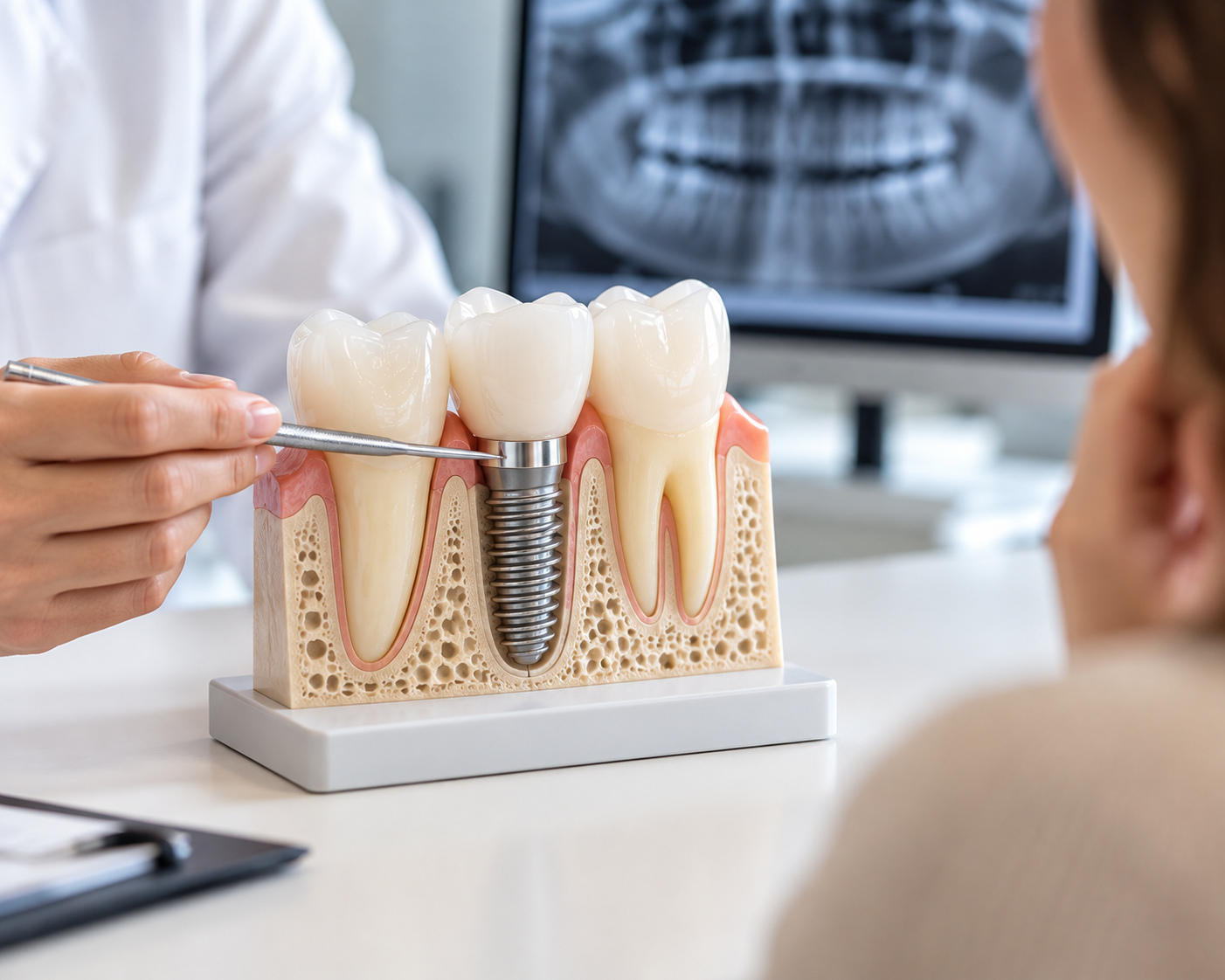
Dental implant treatment can take anywhere from a few months to longer, depending on the healing process and whether extraction, bone grafting, or a sinus lift is required. The implant is merely the artificial root; the final tooth is created after the surgical and prosthetic steps appropriate for the case.
Why isn't there a single term that applies to all implants?
Two people who need a single tooth may be offered treatment plans of different durations. One may have sufficient bone and healthy gums, while the other may require extraction, healing, and bone reconstruction before receiving an implant.
That is why promises such as „full implant in X days” must be interpreted in context. There are situations in which the steps can be combined and situations in which it is biologically safer to keep them separate.
Phase 1: Consultation and Planning
Treatment begins with a clinical examination. The dentist examines the adjacent teeth, the gums, the bite, the available space, and the patient’s medical history. For implantology, 3D imaging may be necessary to assess bone volume and important anatomical structures.
SmileCity offers panoramic X-rays and CBCT scans as part of its services, which allows for the integration of diagnostic imaging into the treatment plan. View current rates for radiology and implantology.
Step 2: Extraction, if the tooth is still present
If the tooth that needs to be replaced is still present, the dentist decides whether the implant can be placed immediately after extraction or whether a healing period is more appropriate. The decision depends on the presence of infection, the condition of the bone, the stability that can be achieved, and the position of the tooth.
Immediate implant placement is not automatically superior. It is an option for suitable cases, not the standard approach for every extraction.
Step 3: Bone grafting, when there is not enough bone
A stable implant requires adequate bone. If the bone is too narrow or has resorbed after tooth loss, bone regeneration may be necessary. Sometimes this is done during the same appointment as the implant placement; other times, it is done beforehand.
Bone healing takes time. Cases involving bone grafting can significantly extend the total duration, but the goal is to achieve a better foundation for the implant.
Step 4: Implant Placement and Osseointegration
The implant is inserted into the bone, and the osseointegration phase begins—that is, the process by which the bone heals around the implant’s surface. This period cannot simply be rushed out of a desire to finish treatment sooner.
In some cases, a temporary restoration may be used, especially in visible areas. It is important that the temporary solution not compromise the stability and healing of the implant.
Step 5: The stump and the final crown
Once the implant is considered integrated and the tissues are prepared, the prosthetic phase begins. The abutment can be placed, and the necessary impression or scan for the crown is taken.
The final crown must be tailored to meet both aesthetic and functional requirements. It is not just „a white tooth,” but a restoration that must fit properly with the adjacent teeth and the bite.
How long can it last in common scenarios?
A simple case, without bone grafting, can be completed in a few months. If an extraction with healing, extensive bone grafting, or a sinus lift is required, treatment may take considerably longer.
The Mayo Clinic and implantology organizations describe the process as a step-by-step procedure, in which a significant portion of the time is devoted to bone healing. The exact timeframe must be determined following diagnostic tests.
Why do some clinics talk about „teeth in a day”?
There are protocols for immediate loading in certain situations, but the term can be misleading. Even if the patient receives a temporary restoration quickly, this does not mean that osseointegration is complete on the same day, nor does it mean that the final restoration is necessarily placed immediately.
The right question is: What will I receive on the day of the procedure, what is temporary, and when will I receive the final restoration?
What can delay treatment?
- slow healing;
- infection or inflammation;
- the need for additional bone grafting;
- a lack of sufficient stability for the next stage;
- gum problems;
- general factors that influence healing;
- the need to adjust the prosthetic plan.
A good plan includes time for check-ins and doesn't treat the schedule as a rigid commitment that ignores biological rhythms.
How can you determine a realistic timeframe for your case?
After the consultation and imaging tests, the doctor can tell you whether you have enough bone, whether an extraction or graft is needed, and when the final stage can be expected. Ask for a step-by-step plan, not just a total number of months.
For the patient, this structure is also helpful from a financial standpoint: they know which procedures are coming up and in what order.
Why shouldn't the final crown be rushed?
The final restoration should be placed once the implant and surrounding tissues have stabilized. If the gum is still remodeling or the implant is not sufficiently integrated, rushing the prosthetic phase can affect the fit, aesthetics, or force distribution.
In the front region, the shape of the gum can be just as important as the implant. Sometimes the temporary phase helps the dentist shape the tissues before the final crown is placed.
How do you plan your time and budget?
Ask for a step-by-step plan with approximate timeframes: diagnostic tests, extraction if necessary, surgery, follow-up visits, the prosthetic phase, and any bone augmentation procedures. This will help you understand what payments are involved and when they are due.
How do you prepare for your appointment, and what information should you bring?
Make a note of when the problem started, what symptoms you’re experiencing, what dental treatments you’ve had in that area, and what medications you’re currently taking. If you have X-rays, CBCTs, medical reports, or documents regarding implants and previous dental work, bring them to your appointment. Tell your dentist if you smoke, have any allergies or chronic conditions, or are undergoing treatments that could affect healing. It’s also helpful to specify what concerns you most: pain, duration, aesthetics, cost, or the number of procedures. An effective consultation isn’t just about receiving a diagnosis—it’s about understanding your options, the sequence of steps, and the reasons why a particular approach is recommended. Ask for clarification if a term is unclear, and ask what happens if you choose to postpone treatment or opt for an alternative. This way, you can make an informed decision and accurately compare your options, rather than relying solely on the price of a single procedure.
Frequently Asked Questions
Are the implant and the crown placed on the same day?
Sometimes an immediate temporary restoration may be placed, but not all cases are suitable. The final crown is determined based on the individual treatment plan.
Why do we have to wait for healing?
The bone needs time to integrate around the implant and form a stable foundation.
Does bone grafting prolong treatment?
It can prolong treatment, especially when it needs to be done before the implant.
Can I go without a tooth during the healing period?
In many cases, there are temporary solutions. The best option depends on the tooth's position and the treatment.
Is it possible to estimate the duration before the implant is placed?
Yes, as a general guideline, following a consultation and imaging tests. The schedule can be adjusted based on your recovery.