
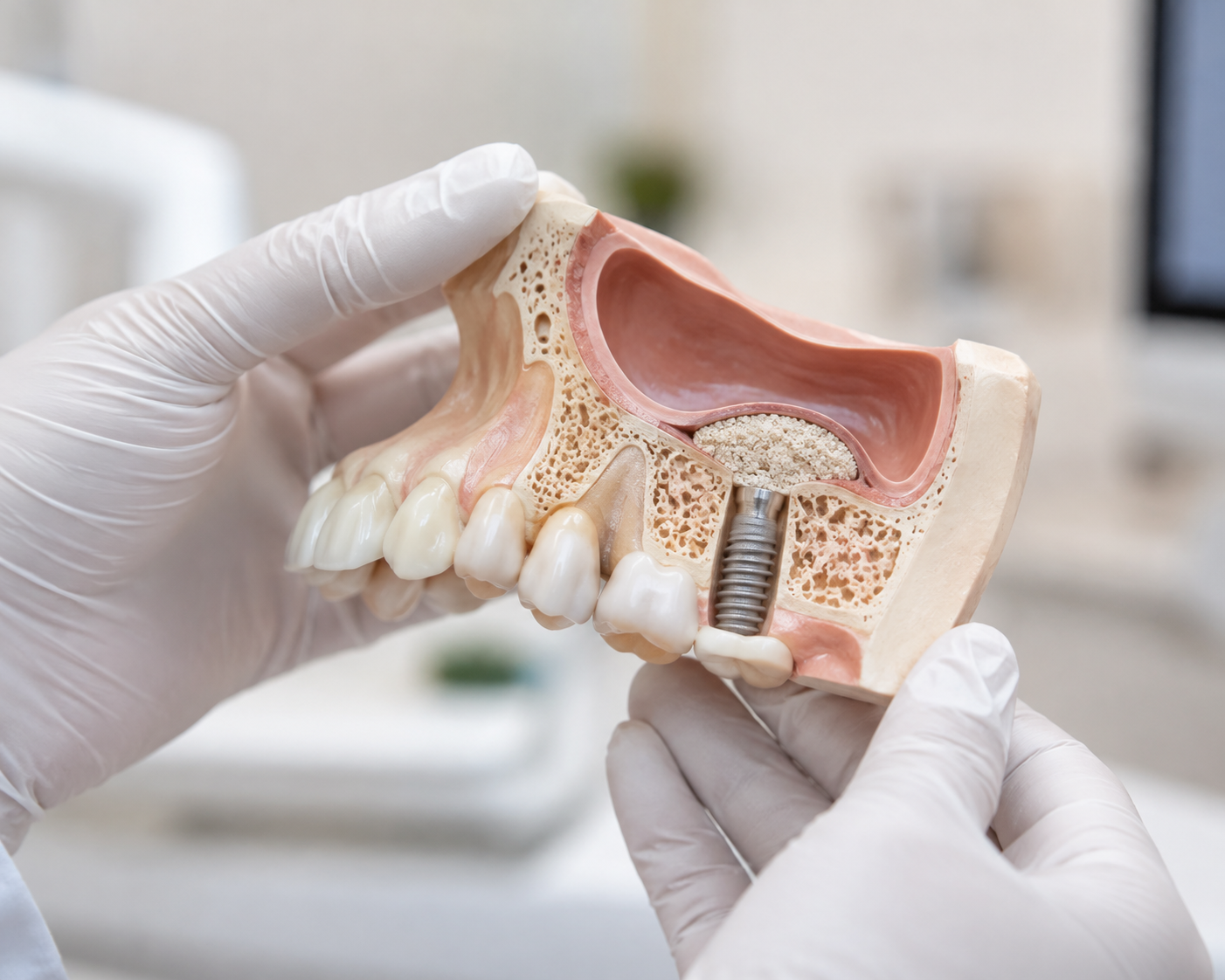
A sinus lift is a bone augmentation procedure used in the posterior region of the upper jaw when there is insufficient bone between the alveolar ridge and the sinus to safely place an implant. It is not necessary for all patients and can be performed using different techniques, depending on the patient’s anatomy.
Where is the sinus, and how is it related to implants?
The maxillary sinuses are cavities located in the maxillary bones, above the upper premolars and molars. When these teeth are lost, the bone in that area can resorb, and the space available for an implant may become too small.
The implant must be planned to ensure adequate bone support. If bone height is insufficient, one possible solution is to elevate the sinus membrane and build bone in the resulting space.
What does „sinus lift” actually mean?
The term may sound dramatic, but it does not mean that the sinus is completely removed. The doctor creates access to the area, carefully lifts the sinus membrane, and inserts augmentation material to provide more bone support over time.
The procedure is well known in implantology and is indicated only after imaging analysis of the patient's anatomy.
How do I know if I need a sinus lift?
A panoramic X-ray can provide an overview, but for three-dimensional planning, the dentist may recommend a CBCT. It helps measure the bone and assess its relationship to the sinus.
Current guidelines for dental radiology emphasize the use of imaging studies when clinically indicated. There is no rule stating that every implant automatically requires a CBCT, but in complex cases, 3D information can be essential.
Internal or external sinus lift: What's the difference?
In simple terms, the internal technique is typically used in select cases where a more limited augmentation is needed, and access is gained through the area prepared for the implant. The external technique creates a lateral window and is frequently used when a more extensive augmentation is necessary.
The choice is not based on the patient’s preference for the „smaller” option, but rather on the amount of bone, the patient’s anatomy, and the implant treatment goal.
Is the implant placed during the same appointment as the sinus lift?
Sometimes, yes, if the existing bone allows for implant stabilization. In other cases, a sinus lift is performed first, and then the bone is allowed to form and mature before the implant is placed.
This difference affects the total duration of treatment, which is why the plan should be discussed in stages.
Does a sinus lift hurt?
The procedure is performed under anesthesia. After the procedure, swelling, pressure, and discomfort may occur, and the doctor will provide specific instructions for the postoperative period.
Because the procedure is performed near the sinus, it is important to follow the recommendations regarding blowing your nose, sneezing, physical exertion, and medication exactly as they apply to you.
How long does recovery take?
Immediate discomfort and bone integration are two different things. You may feel better after a relatively short period of time, while the bone continues to heal for months.
The timing of implant placement or loading is determined based on the type of sinus lift, the volume of bone augmentation, and the clinical course.
What are the risks?
Like any surgical procedure, a sinus lift carries risks. A particular concern is the integrity of the sinus membrane. Infection, bleeding, inflammation, or healing problems may also occur.
Individual risk depends on anatomy, sinus health, smoking, hygiene, and other factors. That is why a consultation and medical history are important.
How much does a sinus lift cost at SmileCity?
SmileCity lists internal sinus lifts and external sinus lifts separately because the procedures differ in scope. View current rates for sinus lifts and dental implants.
The total cost of treatment may also include the implant, diagnostic tests, other augmentation procedures, and the final prosthetic restoration.
The right question to ask if a sinus lift has been recommended to you
Don't just ask, „Can I avoid it?” Ask about the bone height, what type of implant is planned, whether there are alternatives, and what risks or trade-offs avoiding the procedure would entail.
Sometimes an alternative is possible; other times, it would compromise the implant's position or stability. The decision must be explained based on your imaging results.
What should be checked before a sinus lift?
In addition to the amount of bone, the doctor evaluates the appearance of the sinus and the patient’s medical history. Frequent episodes of sinusitis, ENT procedures, or certain anatomical features may require further evaluation before surgery.
If there are active sinus symptoms, they should be reported. The goal is to schedule the procedure in a healthy area with controlled risk.
What is the post-operative period like?
In the first few days, there may be swelling and localized pressure. The patient receives specific instructions on how to protect the sinus and the graft. Some of these recommendations differ from those given after a simple extraction, precisely because the sinus membrane must be protected.
A postoperative follow-up allows the doctor to check how the tissues are healing and to determine when it is safe to proceed to the next stage.
How do you prepare for your appointment, and what information should you bring?
Make a note of when the problem started, what symptoms you’re experiencing, what dental treatments you’ve had in that area, and what medications you’re currently taking. If you have X-rays, CBCTs, medical reports, or documents regarding implants and previous dental work, bring them to your appointment. Tell your dentist if you smoke, have any allergies or chronic conditions, or are undergoing treatments that could affect healing. It’s also helpful to specify what concerns you most: pain, duration, aesthetics, cost, or the number of procedures. An effective consultation isn’t just about receiving a diagnosis—it’s about understanding your options, the sequence of steps, and the reasons why a particular approach is recommended. Ask for clarification if a term is unclear, and ask what happens if you choose to postpone treatment or opt for an alternative. This way, you can make an informed decision and accurately compare your options, rather than relying solely on the price of a single procedure.
Frequently Asked Questions
Is a sinus lift necessary for every dental implant in the upper jaw?
No. It is recommended only when the anatomy and bone volume warrant it.
Which is better: internal or external?
There is no single technique that is universally better. The technique is chosen based on the amount of bone and the patient's anatomy.
Can I get the implant on the same day?
Sometimes, yes, if there is sufficient stability. Other times, the implant is placed after the graft has healed.
Can I fly after a sinus lift?
You should discuss the timing of your trip with your surgeon, as sinus pressure and healing may be factors in the immediate post-operative period.
Can a sinus lift fail?
Yes, just like any other procedure. The doctor discusses the risks and the symptoms that require monitoring.