
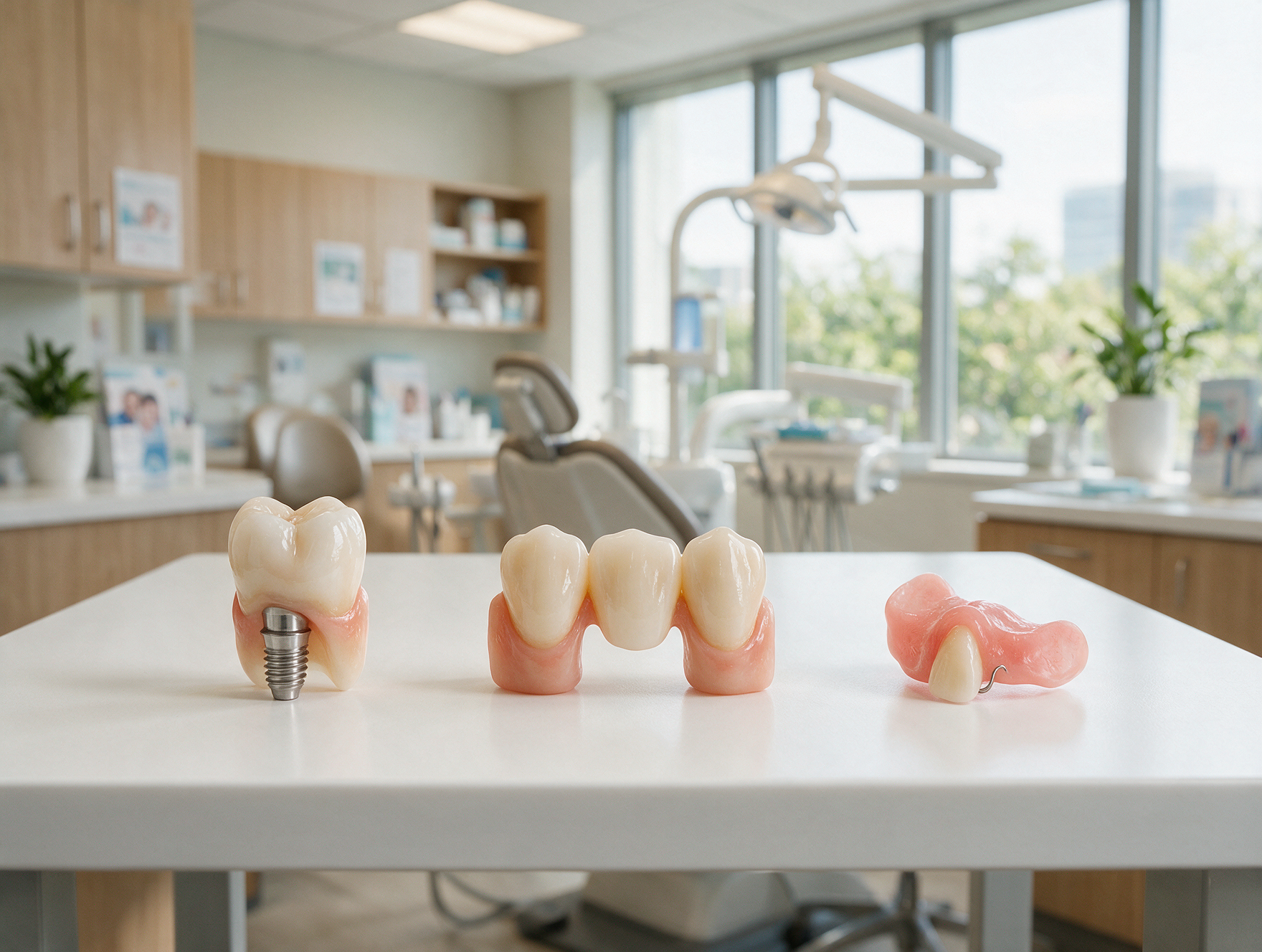
There are several options for replacing a single missing tooth: an implant with a crown, a bridge supported by adjacent teeth, or, in certain situations, a temporary Kemeny-type denture. The choice depends on the condition of the adjacent teeth, the bone, the position of the tooth, aesthetics, time, and budget.
Why is it worth replacing a single missing tooth?
A single gap may seem like a minor problem, especially if it's in the back. Over time, however, the adjacent teeth may tilt, the opposing tooth may shift, and chewing patterns may change.
Aesthetic and phonetic considerations also come into play in the front region. That’s why it’s helpful to discuss your options even if you don’t want treatment right away.
Option 1: Dental implant with a crown
The implant replaces the tooth root and supports a single crown. A major advantage is that it typically does not require the grinding down of adjacent healthy teeth.
The disadvantages are the cost, the surgical procedure, and the healing time. If there is insufficient bone, a bone graft may be necessary, which increases the complexity.
Option 2: Dental Bridge
A bridge uses the adjacent teeth as abutments to support the missing tooth. It can be a good solution, especially if those teeth already have extensive restorations or would benefit from crowns anyway.
If the adjacent teeth are completely healthy, the need to prepare them is a significant drawback that should be discussed. That is why the comparison between implants and bridges does not yield the same answer for every patient.
Option 3: Kemeny prosthesis or temporary solution
The Kemeny denture is a small, removable solution typically used as a temporary replacement for one or more teeth. It can be useful during the healing period following a tooth extraction or implant procedure.
SmileCity lists the Kemeny denture among its prosthetic services. View current prices for dentures, crowns, and implants.
What should I choose for a front tooth?
In the front region, the position of the gum, the shape of the tooth, the color, and symmetry are all very important. An implant can provide excellent results, but the treatment plan must take into account the bone and soft tissues.
Sometimes a temporary solution is used to maintain the appearance of the teeth during the healing period. A bridge may also be an option, depending on the condition of the adjacent teeth.
What should I choose to replace a missing tooth?
For molars, the focus is more on strength and chewing. A single implant is a common option if bone conditions permit, and a bridge may be appropriate in certain prosthetic situations.
The absence of an upper molar can raise concerns regarding the sinus and bone volume. That is why imaging can significantly alter the treatment plan and cost.
Which solution lasts the longest?
There is no guaranteed lifespan. Implants, bridges, and dentures each require different types of care and carry different risks. Oral hygiene, smoking, bite force, bruxism, and regular checkups all affect the outcome.
A well-integrated implant can last a long time, but the crown on top of it can wear down. A bridge can hold up well, but it also depends on the health of the abutment teeth.
How do I compare costs accurately?
With dental implants, there are typically separate costs for surgery and prosthetic restoration. The cost of a bridge depends on the number of units. A temporary prosthesis is more affordable, but it does not provide the same function as a long-term fixed solution.
Ask for a complete plan; don't just compare the price of a single procedure.
If I don't do anything now, what might happen?
The space may remain stable for a while, or tooth migration and bone loss may occur. The more time that passes, the more likely it is that the implant may require additional procedures.
That doesn't mean that every tooth needs to be replaced right away. It means it's worth evaluating and monitoring.
How does the doctor decide?
The adjacent teeth, bone, gums, bite, aesthetics, medical history, and budget are all taken into consideration. A patient with two adjacent teeth that are already compromised may receive a different recommendation than one with perfectly healthy adjacent teeth.
The best solution is one that addresses tooth loss with an acceptable balance between tissue preservation, durability, cost, and maintenance.
How does the condition of the adjacent teeth influence the choice?
If the adjacent teeth have very large fillings, have undergone root canal treatment, or require crowns, a bridge can solve several problems at once. If they are completely healthy, an implant can prevent the need to prepare them.
This is one of the most important differences between the two cases, and the reason why a generic response such as „an implant is always better” is too simplistic.
What role do bite issues and bruxism play?
Chewing forces and teeth grinding affect implants, bridges, and crowns. A patient with bruxism may need a customized prosthetic design and, in some cases, a protective mouthguard.
The plan must address not only the empty space, but also how the new tooth will function within the overall bite.
How do you prepare for your appointment, and what information should you bring?
Make a note of when the problem started, what symptoms you’re experiencing, what dental treatments you’ve had in that area, and what medications you’re currently taking. If you have X-rays, CBCTs, medical reports, or documents regarding implants and previous dental work, bring them to your appointment. Tell your dentist if you smoke, have any allergies or chronic conditions, or are undergoing treatments that could affect healing. It’s also helpful to specify what concerns you most: pain, duration, aesthetics, cost, or the number of procedures. An effective consultation isn’t just about receiving a diagnosis—it’s about understanding your options, the sequence of steps, and the reasons why a particular approach is recommended. Ask for clarification if a term is unclear, and ask what happens if you choose to postpone treatment or opt for an alternative. This way, you can make an informed decision and accurately compare your options, rather than relying solely on the price of a single procedure.
Frequently Asked Questions
Is an implant always better than a bridge?
No. It is often very conservative for the adjacent teeth, but there are situations in which a bridge is warranted.
Can I get an implant if the tooth has been missing for a long time?
Often, yes, but the bone needs to be evaluated. Bone grafting may be necessary.
Is there a temporary tooth until the implant is placed?
Yes, there are several temporary options, including small Kemeny-type prostheses in appropriate cases.
Does the bridge require the adjacent teeth to be ground down?
In the traditional approach, yes, the abutment teeth are prepared for crowns.
Which option is the cheapest?
The cost varies depending on the case. Temporary solutions are often more affordable, but they are not functionally equivalent to an implant or a bridge.