
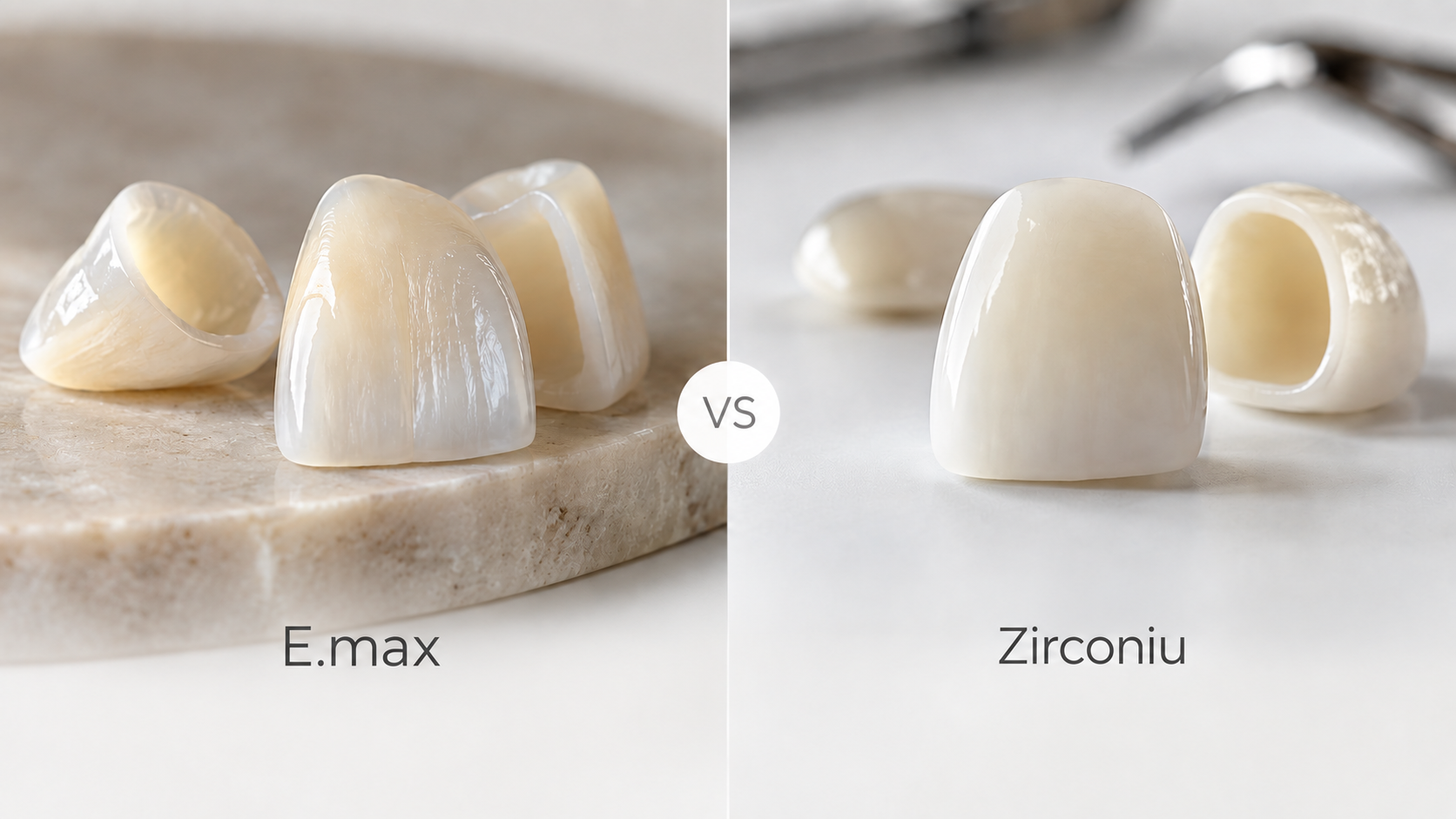
For front teeth, Emax is often chosen when a very natural appearance is the top priority, while zirconia may be preferred in situations where other strength properties or substrate masking are required. However, there is no single material that is universally superior. The choice depends on the tooth being restored, its color, the bite, and the aesthetic goal.
What is Emax ceramic?
Emax is a lithium disilicate-based ceramic used for aesthetic restorations such as veneers, crowns, and certain inlays and onlays. Its main advantage in the anterior region is its ability to replicate the translucency and brightness of a natural tooth.
What is zirconium?
Zirconia is a highly durable ceramic material commonly used for crowns and bridges. Modern versions can offer excellent aesthetics, but their optical properties vary depending on the type of zirconia and the thickness of the restoration.
Which one looks more natural on an incisor?
In many cases, Emax offers a translucency that is well-suited for incisors, especially when the underlying tooth is not very dark in color. However, a natural-looking result also depends on the dental technician, the tooth preparation, and how well the restoration integrates with the adjacent teeth.
When is zirconium the preferred choice?
Zirconia can be useful when high strength is required, when certain bite conditions exist, or when a darker base needs to be masked. The dentist selects the appropriate type of material based on the clinical case, not just on aesthetic preference.
Which one is more durable?
Zirconia generally has very high mechanical strength. Emax also has good strength for the appropriate indications. It is important that the material be used where its properties match the forces involved and the available thickness.
Which one preserves more of the tooth?
The amount of material needed is not determined solely by the name of the material. It depends on the type of restoration, the color of the underlying tooth, its position, and the space required for the ceramic. A conservative treatment plan aims to preserve as much healthy tissue as possible.
Can Emax be combined with zirconia?
In a more complex restoration, the dentist may use different materials on different teeth, depending on aesthetic and functional requirements. What’s important is that the final result be harmonious; it’s not necessary for all restorations to be made of the same material.
How much do Emax and zirconia cost at SmileCity?
SmileCity publishes pricing for Emax ceramic crowns and monolithic zirconia crowns, as well as for Emax veneers. For the most up-to-date prices, visit the SmileCity pricing page. See SmileCity prices
How do you choose the right material?
The choice is made after evaluating the tooth and the smile. If the priority is optical integration in a highly visible front area, Emax may be an excellent option. If there are different mechanical requirements, zirconia may be more suitable. The dentist must balance aesthetics, strength, and tooth preservation.
Why are Emax and zirconia compared so often?
Both are ceramic materials commonly used in modern prosthetics, but they have different properties. Emax is valued for its translucency and aesthetic integration, while zirconia is valued for its strength and wide range of applications. Current technologies have made zirconia much more aesthetically pleasing than in the past, so the choice can no longer be reduced to the idea that „Emax is for aesthetics, zirconia is for strength.” The clinical context matters.
What does translucency mean for a front tooth?
Natural teeth are not completely opaque. Light passes through enamel and dentin differently, and this depth contributes to their natural appearance. Materials with the right translucency can better mimic this effect. However, if the tooth beneath the crown is very dark in color or there is a metal post, the dentist may need a material or level of opacity capable of masking the underlying structure.
Does the color of the tooth underneath the restoration affect your choice?
Yes. A natural tooth with a favorable shade is different from a heavily pigmented tooth stump or a tooth with old restorations. For predictable aesthetic results, the dentist and dental technician must know which color needs to be masked and how much space is available for the ceramic. Sometimes the material considered the most translucent is not automatically the best choice.
What role do tooth alignment and bite play?
Incisors and canines are subjected to different stresses than molars, and patients have individual bite patterns. Bruxism or strong occlusal forces may affect the recommendation. In some cases, the priority is maximum aesthetic integration; in others, resistance to forces becomes equally important. The correct decision strikes a balance between these two objectives.
How do you actually choose between Emax and zirconia?
The dentist evaluates the tooth, the surrounding tissues, the color of the tooth structure, the available space, the bite, and the appearance of the adjacent teeth. Only then is the choice of material discussed. For the patient, the useful question is not „which material is generally the best?” but „which one offers the best combination of aesthetics and durability for my tooth?”.
Which material looks more natural in photos and under bright light?
There is no one-size-fits-all answer, as the result depends on the thickness of the restoration, the color of the substrate, the layering, and the technician’s experience. A properly selected Emax can reproduce natural translucency very well, but modern zirconia can also deliver excellent aesthetic results. More important than the name of the material is that the restoration be designed for the specific case and harmonize with the adjacent teeth.
What questions should you ask before choosing a material?
Ask your dentist why they recommend that particular material for your tooth, what trade-off exists between aesthetics and durability, how the underlying color will be masked, and what maintenance is required. A good answer should be based on your specific case, not on a general rule applied to all patients.
Frequently Asked Questions
Is Emax more attractive than zirconia?
In the anterior region, it may offer aesthetic advantages, but the outcome depends on the specific case and the quality of the restoration.
Is zirconia suitable for front teeth?
Yes, in certain situations and with the right type of zirconium.
Can Emax break?
Any dental restoration can be damaged under certain conditions, especially when subjected to excessive force or trauma.
Which material is better for bruxism?
An individual assessment is required. Bruxism can influence both the choice of material and the need for additional protection.
Do Emax and zirconia have different colors?
Both can be customized in terms of color, but they have different translucency properties.